

 Back Home
Is Winter Actually a Better Time to Buy a Home in Dane County?
 November 20th, 2026 by keithandkinsey
What five years of local real estate data tells us about competition, negotiating power, and the best time to buy.
Spring and summer have traditionally been the busiest seasons in real estate. More homes hit the market, buyers become more active, and competition heats up. But does that mean winter is actually a better time to buy?
We’ve often told buyers that the slower winter months can offer some advantages. Fewer buyers are actively looking, sellers may be more motivated, and there’s often more room to negotiate.
But we wanted to see whether the numbers actually support that advice.
We analyzed five years of Dane County single-family home sales data from Redfin, covering 2021 through 2025. What we found was pretty compelling.
Winter Buyers Really Do Have More Negotiating Power
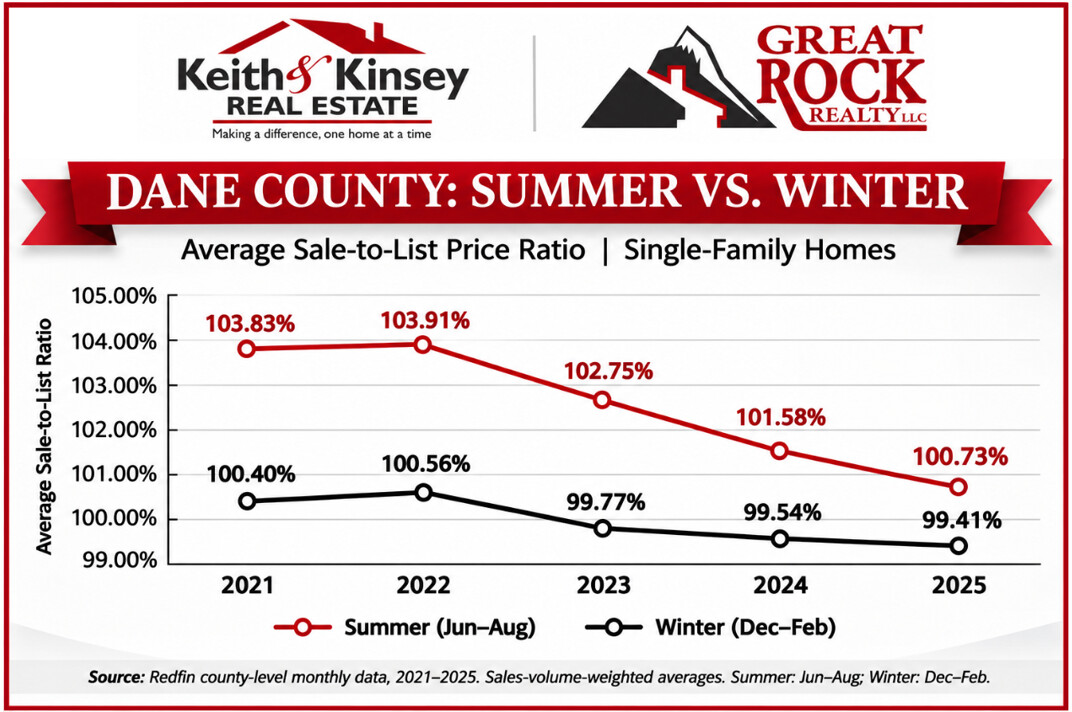
Over the past five years, buyers purchasing single-family homes in Dane County during June, July, and August paid an average of 102.74% of the asking price.
During December, January, and February, that average dropped to 99.97%.
That’s a difference of 2.76 percentage points.
To put that into perspective, on a home listed for $450,000, a 2.76-percentage-point difference represents approximately $12,400.
That doesn’t mean every buyer can save $12,400 simply by purchasing in winter. Every home and transaction is different. But it does demonstrate a meaningful seasonal difference in what buyers are paying relative to asking prices.
And this wasn’t just an unusual year. The pattern appeared in all five years we examined.
Fewer Bidding Wars, More Opportunities to Negotiate
Perhaps even more revealing is how often homes sell above or below their asking prices.
| Dane County single-family sales, 2021–2025 | Summer | Winter |
|---|---|---|
| Average sale-to-list-price ratio | 102.74% | 99.97% |
| Homes selling above asking price | 56.5% | 34.2% |
| Homes selling below asking price | 22.7% | 37.2% |
During the summer, more than half of all homes sold above asking price. In winter, that dropped to roughly one-third.
Meanwhile, the percentage of homes selling below asking price increased from 22.7% in summer to 37.2% in winter.
This is important because it tells us something that median sale prices alone cannot: buyers are generally facing less competition and achieving more favorable negotiating outcomes during the winter months.
That can mean more opportunities to negotiate not only on price, but potentially on inspection issues, closing costs, and other terms of an offer.
What About the Seasonal Decline in Home Prices?
We also looked at Dane County’s median sale prices and found another interesting trend.
From 2021 through 2025, the median sale price declined an average of 6.8% between June and December, even as home values generally increased from year to year.
At first glance, that might suggest homes are simply cheaper in winter.
But there’s an important distinction.
Median sale price measures the middle price of all homes sold during a particular period. It doesn’t necessarily measure what an individual home is worth.
For example, higher-end homeowners may have more flexibility to wait until spring to list their properties, while other sellers may need to move regardless of the season. If fewer expensive homes sell during winter, the median sale price could decline even if the underlying values of comparable homes haven’t changed.
Our data doesn’t establish whether that is happening in Dane County, but it’s one reason we wouldn’t interpret the 6.8% seasonal decline as a direct discount on home values.
The sale-to-list-price data provides stronger evidence of a winter negotiating advantage because it compares actual selling prices against the asking prices of the homes being purchased.
The Trade-Off: Fewer Homes to Choose From
Of course, there’s a downside to buying during the winter.
Fewer homeowners list their properties during the colder months, which means buyers have less selection.
Our five-year analysis found approximately twice as many single-family home sales during June through August as during December through February.
If you’re looking for a very specific neighborhood, floor plan, school district, or property feature, waiting until spring could give you more options.
Winter weather can also make it harder to evaluate certain aspects of a property, including roofing, landscaping, grading, and exterior drainage. On the other hand, cold weather can reveal heating problems, drafts, and insulation issues that might be less noticeable during warmer months.
Should You Buy This Winter or Wait Until Spring?
There isn’t one answer that works for everyone.
If you’re searching for a very specific property and aren’t in a hurry, spring may provide more opportunities to find exactly what you want.
But if you’re flexible and find a home that meets your needs during the winter, the data suggests you may have a better opportunity to negotiate favorable terms.
Mortgage rates are another consideration, but trying to perfectly time both home prices and interest rates is difficult. If rates decline, additional buyers may enter the market and increase competition. If rates remain elevated, buyers may continue to have more negotiating room.
The important thing is to evaluate the overall opportunity rather than focusing exclusively on the season.
The Bottom Line
After analyzing five years of Dane County home sales, we can say there’s real evidence supporting something we’ve observed for years: winter can be an excellent time to buy a home.
The biggest advantage isn’t necessarily that homes are worth less in winter. It’s that fewer buyers are competing for them.
With fewer bidding wars, a greater percentage of homes selling below asking price, and sellers who may be more willing to negotiate, winter buyers often find opportunities that are harder to come by during the busy spring market.
And while the advantage has narrowed as our market has become more balanced, it certainly hasn’t disappeared.
If you’re considering buying a home, don’t automatically assume you need to wait until spring. You might find that the best opportunity is already on the market.

Keith & Kinsey Real Estate | Great Rock Realty
Data source: Redfin county-level monthly housing market data, Dane County, Wisconsin, single-family residential properties, January 2021–December 2025. Seasonal comparisons use June–August for summer and December–February for winter, with monthly statistics weighted by the number of homes sold. Figures represent historical market averages, not guaranteed savings or changes in comparable property values.


Leave a Reply
You must be logged in to post a comment.